
Graywater Reuse 101
Got a Question about Graywater Reuse?
What is Graywater Reuse?
Traditionally, wastewater from your home flows either into your city’s centralized wastewater collection system or into your own septic system if you live in an area without access to a centralized sanitary sewer system. Over the years, the definition of “wastewater” in the international plumbing code has been divided into two categories, blackwater and graywater.
Graywater is defined as wastewater from bathroom sinks, bathtubs and showers, and clothes washing machines. Therefore, blackwater is defined as wastewater from toilets, kitchen sinks, and dishwashers. These are the common definitions set forth by the international plumbing code which is the approved code for many cities across the US. In comparison, graywater is relatively clean and does not require the same treatment as blackwater. Creating these separate definitions now allows the use of graywater as a water conservation opportunity since graywater does not have to be directed to the sanitary sewer or septic system like blackwater does.
In 1992, Texas passed a law allowing water from clothes washing machines to be classified as graywater. TCEQ has recently passed the proposed changes to the Texas Administrative Code Section 210 (Use of Reclaimed Water) to allow water from showers, bathtubs, bathroom sinks and clothes washing machines to be called graywater.
On a large scale, municipalities across the United States are starting to implement water reuse programs that reuse wastewater treatment plant effluent for non-potable purposes such as the landscape irrigation or cooling water. This water is called “reclaimed water” and should not be confused with graywater. These two water sources are completely different. At this time, you will mostly see reclaimed water systems supplying large users of water such as golf courses and power plants.
Even though graywater reuse is not allowed in all states, we believe that graywater recovery will grow and become legal as more states begin to contend with water supply issues.
What are the benefits of graywater reuse?
- You have already paid for the water
- It only needs a minimal amount of treatment (in comparison to black water)
- You will offset the use of potable water for landscape irrigation
- You can keep a consistent soil moisture level around your home’s concrete slab which may help to prevent the movement and cracking of your slab
Why is graywater reuse so important?
Graywater reuse is important for several reasons but one of the biggest is the fact that we are tapping out water conservation gains inside our homes so we need to start looking for other ways to conserve than through traditional channels.
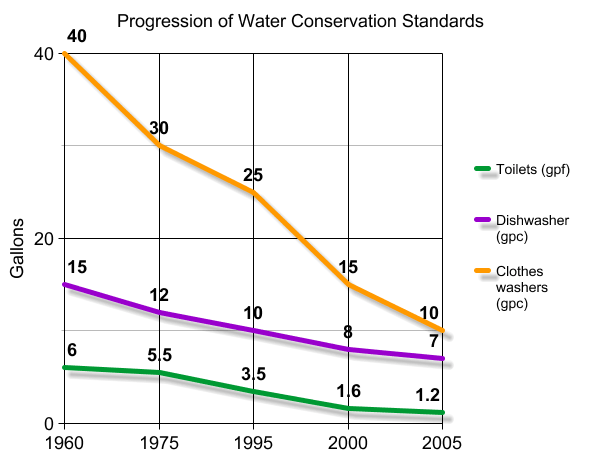
The following graph shows the gains that have been achieved with our indoor water fixtures through the combination of governmental standards and innovation by fixture companies. As you can see, we don’t have much more room to go in terms of achieving more efficiency gains with our indoor fixtures. What’s next… the 0.2 gallon per flush toilet? Probably not!
This phenomenom is known as the law of diminishing returns. So where will the next revolution in water conservation take place? We believe we offer services in the areas where this revolution will take place.
How can I use graywater?
Graywater recovery systems allow you to reuse water to irrigate your lawn and landscape plants, used around the foundation of your house to minimize foundation movement, and/or be used in your toilets. This will help you save money on your water bills. Unlike rain, graywater is a constant and reliable source of water that should be harnessed. You pay for water once when it passes your water meter, why not use it as many times as possible?
Latest Graywater Reuse FAQ

How much graywater does my home produce?
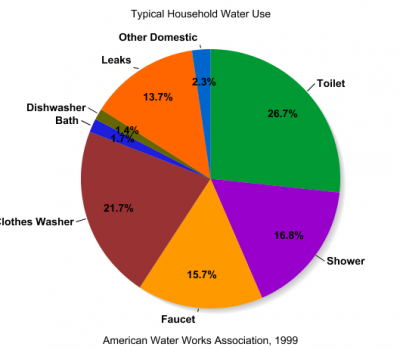
This chart shows the percentages of the various components of typical household water use. From this data, one can see that approximately 55% of the water that is used in a typical household can now be used as graywater. On average, a family of four, uses 300 gallons of water a day. 160 gallons of this 300 gallons can now be used in the ways decribed above. These 160 gallons can offset the amount of water needed to water your lawn and landscaping.
The categories in the lower portion of the pie chart from “Bath” to “Shower” are all considered graywater in the states that currently have graywater laws. As you can see, this amounts to approximately 56% of your indoor water use. Imagine reusing this graywater on your landscaping rather than paying for treated municipal to water your landscaping.
Is graywater reuse the future of water conservation?
We believe graywater reuse will become a larger piece of the water conservation discussions as we move forward with the pressures on our local water resources. At this point, only a handful of states approve the use of graywater in or around your home. As pressures increase on our water resources, other states will join the effort. Our graywater regulations center can help your keep current on graywater regulations in your own state.
What are the different methods for reusing graywater?
If graywater reuse is allowed in your area, then here are the various methods of graywater reuse.
Single Fixture System
A single fixture system routes the graywater from one or two fixtures and distributes the graywater by gravity to generally one landscape area. This system normally collects the graywater from the the washing machine especially if the washing machine is installed along an exterior wall of the house. The waste pipe is intercepted and routed out the exterior wall to the closest landscape area.
Gravity, Branched Drain System
This graywater recovery system expands on the idea of the single fixture system but uses a branched drain pipe network to distribute the graywater to multiple landscape areas. The graywater is still distributed by gravity so the main issue with this type of system is ensuring an even distribution of the graywater to all of the landscape areas desired. The main benefit of this system is the low capital cost but the main disadvantage is that the distribution pipes can become clogged over time.
Pumped Graywater System
A pumped graywater reuse system collects graywater by gravity from the various fixtures in the house, but then the graywater is pumped to the desired landscape areas. A filter may be installed in the system in order to reduce the amount of debris that could clog the distribution pipes. The main benefit of this type of system is that the graywater gets distributed over a larger area and even uphill but the higher capital cost is a disadvantage.
When should or can I install a Graywater Recovery System?
The most economical way to install a total graywater system (a system that captures all of the graywater produced) in a house is to plan it into the construction of the house. You will be able to place the necessary plumbing to recover all of the graywater. Retrofitting existing homes where the plumbing is located in a concrete floor is nearly impossible and is usually limited to recovering washing machine water only.
What kind of precautions are taken?
Graywater should never be stored for long periods of time, since we are constantly producing it and because of its ability to turn septic with a presence of bacteria. There are many precautions that are specified in the graywater regulations passed by TCEQ. The graywater surge tank should have an overflow valve leading to the sanitary sewer or septic system to prevent overflow and flooding. Also, homeowners should have the ability to direct all graywater flow to the sanitary sewer or septic system when desired or when water is not needed in the quantities produced by the household. A sand filter can be used to remove unwanted solid material and a pump transports the graywater to the drip irrigation system or to the toilets located within your home.
How can Innovative Water Solutions help me out?
Find out about our Graywater Reuse System Installation Services.