
Rainwater Harvesting 101
Got a Question about Rainwater Harvesting? Ask it here.
What is Rainwater Harvesting?
Rainwater harvesting is collecting the run-off from a structure or other impervious surface in order to store it for later use. Traditionally, this involves harvesting the rain from a roof. The rain will collect in gutters that channel the water into downspouts and then into some sort of storage vessel. Rainwater collection systems can be as simple as collecting rain in a rain barrel or as elaborate as harvesting rainwater into large cisterns to supply your entire household demand.
The idea of rainwater harvesting usually conjures up images of an old farm cistern or thoughts of developing countries. The reality is that rainwater harvesting is becoming a viable alternative for supplying our households and businesses with water. It’s not just for the farm anymore! There are many countries such as Germany and Australia where rainwater harvesting is a norm. Due to the green building movement, you will be seeing rainwater harvesting systems become more popular here in America.
The collection of rainwater is known by many names throughout the world. It ranges from rainwater collection to rainwater harvesting to rainwater catchment. In addition, terms such as roofwater collection or rooftop water collection is also used in other countries.
We believe that rainwater harvesting is a viable technology in an urban setting. All that is necessary to take advantage of this resource is to capture the free water falling on your roof and direct it to a rainwater storage tank. By doing this, you can take control of your water supply and replace all or at least a substantial portion of your water needs. Rainwater harvesting systems can be configured to supply your whole house and/or your landscape needs.
What are the Benefits of Rainwater Collection?
- Rainwater is a relatively clean and absolutely free source of water
- You have total control over your water supply (ideal for cities with water restrictions)
- It is socially acceptable and environmentally responsible
- It promotes self-sufficiency and helps conserve water
- Rainwater is better for landscape plants and gardens because it is not chlorinated
- It reduces stormwater runoff from homes and businesses
- It can solve the drainage problems on your property while providing you with free water
- It uses simple technologies that are inexpensive and easy to maintain
- It can be used as a main source of water or as a back up source to wells and municipal water
- The system can be easily retrofitted to an existing structure or built during new home construction
- System are very flexible and can be modular in nature, allowing expansion, reconfiguration, or relocation, if neccesary
- It can provide an excellent back-up source of water for emergencies
Not enough benefits for you? Discover more rainwater harvesting advantages.
Why is Rainwater Harvesting Important?
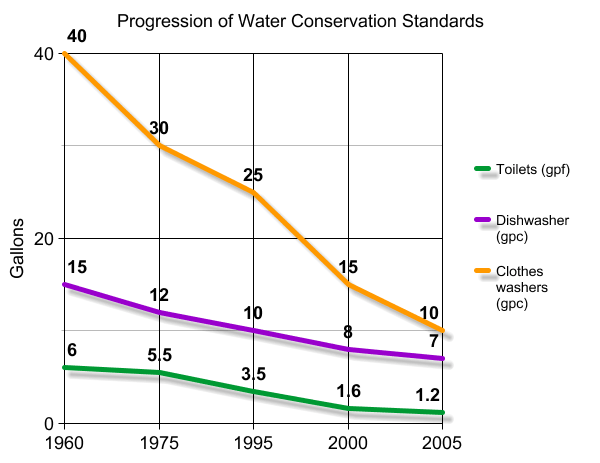
Rainwater harvesting is important for several reasons but one of the biggest is the fact that we are tapping out water conservation gains inside our homes so we need to start looking outdoors for more opportunities.
The following graph shows the gains that have been achieved with our indoor water fixtures through the combination of governmental standards and innovation by fixture companies. As you can see, we don’t have much more room to go in terms of achieving more efficiency gains with our indoor fixtures. What’s next… the 0.2 gallon per flush toilet? Probably not!
This phenomenom is known as the law of diminishing returns. So where will the next revolution in water conservation take place? We believe we offer services in the areas where this revolution will take place.
What are the uses of collected rainwater?
You can essentially use rainwater anywhere you use tap water. The idea of using drinking water to flush our toilets and water our lawns is wasteful and irresponsible, especially in light of population growth and water shortages across the country. Rainwater collection is a technique to green your home and to lessen your environmental footprint.
There are basically three areas where rainwater can be used:
- Irrigation use
- Indoor, non-potable use
- Whole house, potable use
Here are some ideas for specific uses of rainwater:
- Hand water your lawn and garden
- Connect rainwater collection system to irrigation/sprinkler system
- Wash your vehicles
- Wash your pets
- Refill your fountains and fish ponds
- Refill your swimming pool
- Replace the use of tap water with rainwater to wash your driveways and sidewalks (if you don’t use a broom)
- Use it for all indoor non-potable fixtures (toilets and clothes washer)
- Use it for all potable needs when properly filtered and disinfected
- Use it for industrial processes instead of municipally treated water
So just how much rain can I collect?
The amount of rainfall that you can collect is governed by the following formula:
1″ of rain x 1 sq. ft. = 0.623 gallons
To calculate the amount of rainwater you can collect, you need to know your annual average precipitation for your area. You can use the precipitation map below to find an approximate amount for your area.
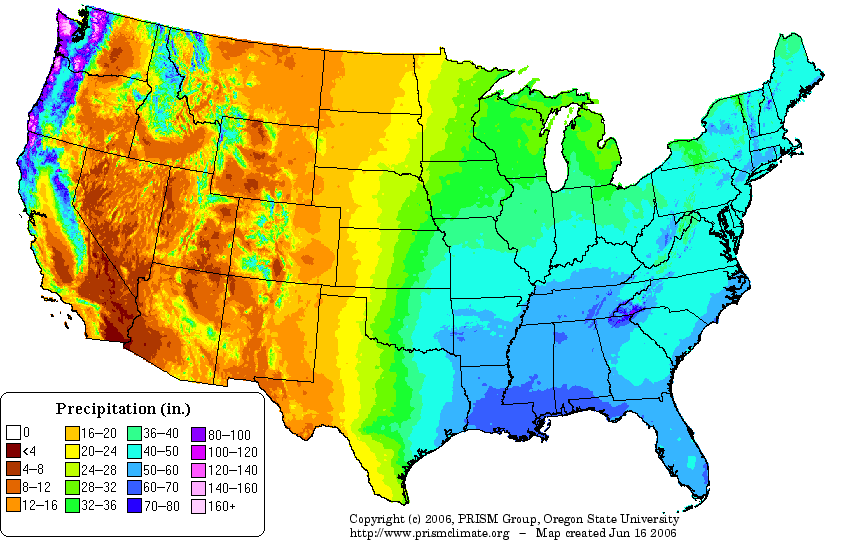
Alternatively, you can find an exact precipitation amount by looking at the NCDC Monthly Precipitation Probabilities and Quintiles.
Find the closest weather station to you and use the 0.5 row to determine your annual average precipitation.
Once you have the annual average rainfall in your area and the square footage of your collection surface, you can plug these values into our rainwater collection calculator below.
How to harvest rainwater
So you’re convinced that you want to start collecting rainwater at your house. Below you will find the resources to educate yourself on the best method for harvesting rainwater in your situation. You will also find information about the basic components of a rainwater collection system. Even though rainwater catchment is an old technology, there have been many improvements over time through product innovations.
What are the different methods to collect rainwater?
The only thing that differs in the following methods is the scale of the system. They all follow the same principles but differ on aesthetics and actual water conservation effectiveness. Click the pictures for a closer look.
Rain Barrels
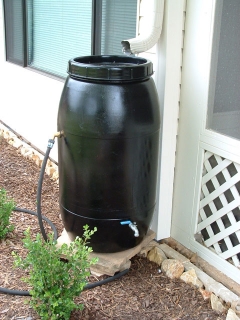
This method is the most common and one that many people are familiar with. This involves installing a barrel at a gutter downspout to collect rainwater. The actual barrel may be a recycled barrel or a new commercially available rain barrel.
Pros:
- Easily implemented by anyone at any residence
- Barrels are readily available in your community or at various stores & websites
- Barrels don’t take up much space so they can fit into any situation
Cons:
- Capacity is generally only 50 to 100 gallons
- Easily overflows and wastes collection opportunities
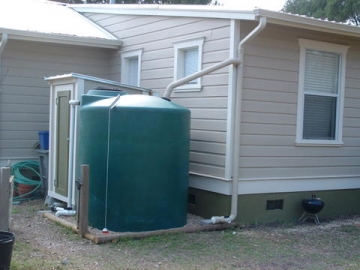
“Dry” System
This method is a variation of a rain barrel set-up, but it involves a larger storage volume. Essentially, the collection pipe “drys” after each rain event since it empties directly into the top of the tank.
Pros:
- Can store a large amount of rainwater
- Great for climates where rainfall happens with infrequent, larger storm events
- Can be inexpensive to implement
- Less complicated system so maintenance is easier
Cons:
- The storage tank must be located next to your house

“Wet” System
This method involves locating the collection pipes underground in order to connect multiple downspouts from different gutters. The rainwater will fill the underground piping and the water will rise in the vertical pipes until it spills into the tank. The downspouts and underground collection piping must have water-tight connections. The elevation of the tank inlet must be below the lowest gutter on the house.
Pros:
- The ability to collect from your entire collection surface
- The ability to collect from multiple gutters and downspouts
- The tank can be located away from your house
Cons:
- More expensive to implement due to underground piping
- Sufficient difference between gutters and tank inlet must be available
How do I create a complete rainwater collection system?
The image below shows a complete rainwater collection system. While some of the components shown are absolutely necessary, not all of the components listed are required. Although, all of these components will help create a harvesting system that is highly functional and nearly maintenance-free.
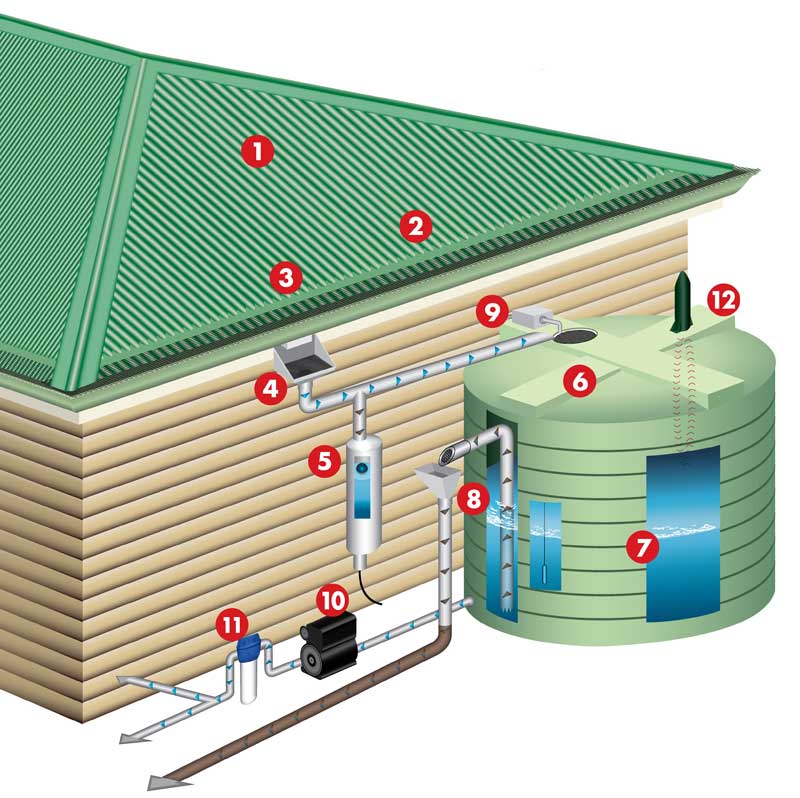
- It all starts with your ROOF SURFACE. Nearly all roof surfaces are fine for rainwater harvesting.
- Your gutters should have some sort of GUTTER PROTECTION SCREENING in order to keep large debris from entering the gutters.
- You can collect rainwater from any type and shape of GUTTER. You do not need a special gutter for harvesting rainwater.
- An additional filtration opportunity is with the installation of a RAIN HEAD (downspout filter) that allows for a bit of self-cleaning filtration options.
- A FIRST-FLUSH DIVERTER helps to prevent the first flush of contaminated rainwater from entering the tank.
- Another rainwater filtration opportunity is with a TANK SCREEN that is installed on the tank entry point. It also helps to keep mosquitoes and pests out.
- RAINWATER TANKS come in all sorts of sizes and materials. Click to learn more about all the various types of rainwater harvesting tanks available on the market.
- Install an INSECT PROOF FLAP VALVE on the end of the overflow pipe to keep mosquitoes and pests out.
- An AUTO-FILL SYSTEM can be installed to keep a minimum amount of water in the tank at all times. This is very important for rainwater tanks that are connected to automatic irrigation systems in order to prevent the pump from running dry.
- Select a PUMP SYSTEM to provide pressurized rainwater to distribute the rainwater easier or to connect to an inground irrigation system.
- Install an IRRIGATION FILTER inline after the pump in order to catch any large debris that may have gotten through the pump.
- A WATER LEVEL INDICATOR can be helpful with monitoring the water usage from the tank. Those are available in simple gauge tank options along with wireless digital options.
Latest Rainwater Harvesting FAQ